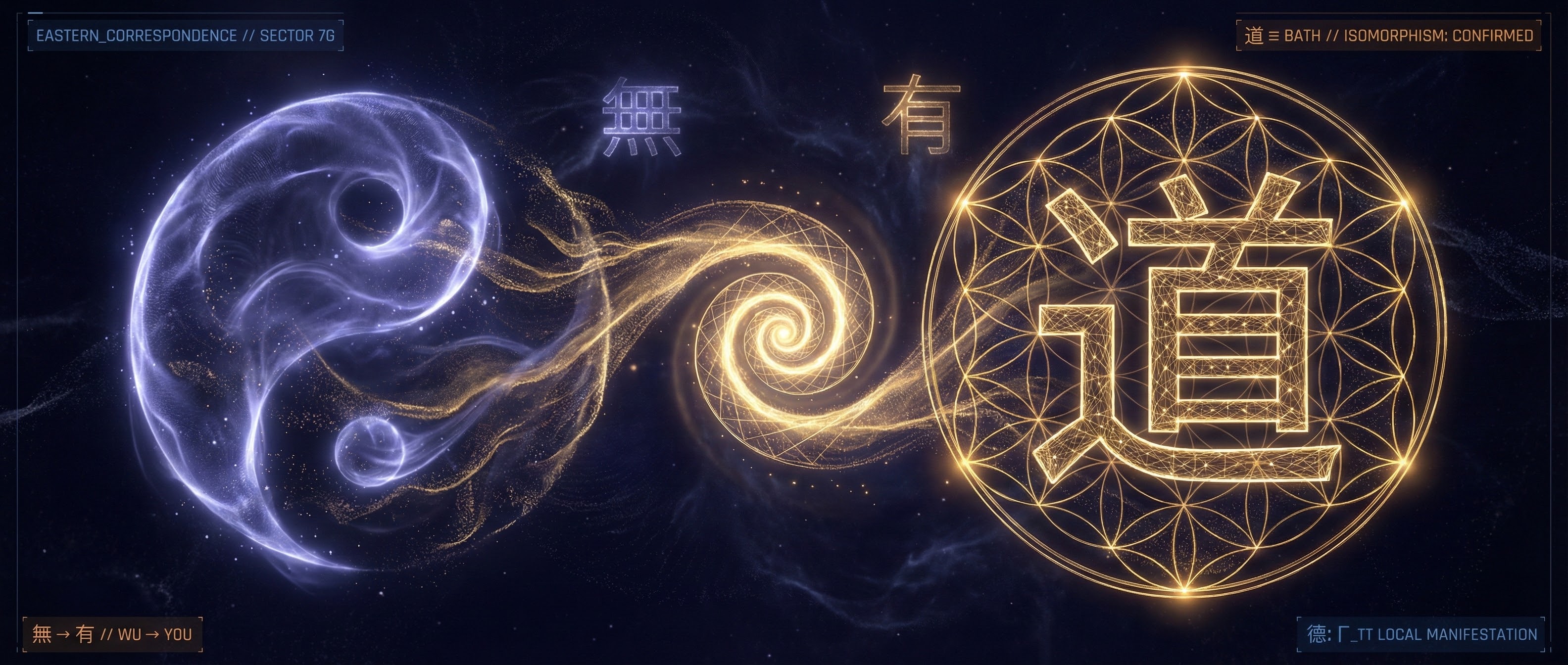
This is not a claim that ancient seers knew quantum mechanics. They did not have interferometers, and we should not pretend otherwise. What follows is a narrower and more honest observation: three independent intellectual traditions, separated by centuries and continents, arrived at the same specific ontological claim — that persistence requires active renewal at each moment. That convergence is interesting. This essay asks why it happened, and what it can and cannot tell us.
I. The Convergence
Ash'ari Occasionalism
In the Islamic theological tradition of kalām, the Ash'ari school (founded by Abū al-Ḥasan al-Ash'arī, d. 936 CE) developed a radical doctrine: physical properties have no inherent continuity. Colour, motion, position, material existence itself — these are "accidents" (a'rāḍ) that must be actively re-created at each discrete instant.
The mutakallimūn (Islamic dialectical theologians) saw time not as a continuous river but as a sequence of discrete "nows" (آنات). At each instant, the world is annihilated and re-created. What we perceive as persistence is not an enduring substance but an unbroken chain of renewal — tajdīd al-khalq (تجديد الخلق), continuous creation.
For al-Ghazālī (d. 1111 CE), this meant there is no secondary causation: fire does not burn cotton by its own nature. What we call "burning" is a fresh act of creation that happens to follow a pattern. The universe is sustained not by mechanical law but by continuous re-rendering.
The agent in this account is God. That is essential to the Ash'ari framework and should not be abstracted away.
Kashmir Shaiva Spanda
The Spanda doctrine of Kashmir Shaivism (9th–10th century CE) centres on the claim that reality is constituted by vibration — the continuous pulsation (spanda) of consciousness between manifestation and dissolution.
तं शक्तिचक्रविभवप्रभवं शंकरं नुमः॥
Taṃ śakticakravibhavaprabhavaṃ Śaṃkaraṃ numaḥ ||
"We praise that Śaṅkara by whose opening and closing of eyes the world arises and dissolves." The key terms:
- Unmeṣa (उन्मेष) — Opening. The world manifests.
- Nimeṣa (निमेष) — Closing. The world dissolves.
This is not a one-time cosmological event. It is the ongoing structure of each moment. Reality flickers — it is perpetually arising and subsiding. What persists is the vibration itself, not any static substance.
The agent in this account is Śiva-as-consciousness. The pulsation is an intrinsic property of awareness, not an external force acting upon inert matter.
Abhidharma Buddhist Momentariness
The most analytically precise version of this idea comes from the Abhidharma Buddhist tradition, particularly the doctrine of kṣaṇavāda (क्षणवाद) — the theory of momentariness.
In this analysis, what we call a "thing" is actually a santāna (सन्तान) — a causal stream of momentary events. A flame is not a persisting object; it is a rapid succession of distinct fire-moments, each causing the next. A person is not a substance but a stream of psychophysical events (the five skandhas) arising and passing away at each kṣaṇa.
The Sautrāntika school formalized this rigorously: an entity exists only at the moment of its arising. In the very same instant, it performs its causal function and ceases. There is no duration — only origination, function, and cessation compressed into a single moment.
Crucially, there is no agent in this account. No god, no consciousness-substrate. Just process. The stream sustains itself through dependent origination (pratītyasamutpāda) — each moment conditions the next without any external sustainer.
II. The Structure — And the Differences
All three traditions assert the same core structure: what appears to persist is actually being renewed at each moment. Static being is an illusion; reality is a process of continuous re-arising.
But they diverge sharply on mechanism and metaphysics. These differences matter and should not be papered over:
| Ash'ari | Spanda | Abhidharma | |
|---|---|---|---|
| Core claim | Accidents do not persist for two moments | Reality pulses between manifestation and dissolution | All dharmas are momentary |
| Agent | God (Allah) — external, volitional | Śiva-as-consciousness — intrinsic pulsation | No agent — dependent origination |
| Time | Discrete instants (آنات) | Pulsation (spanda) of awareness | Discrete moments (kṣaṇa) |
| What persists | God's continuous will | The vibration of consciousness | Nothing — only causal streams |
| Causation | Denied — only divine habit | Expression of consciousness | Dependent origination between moments |
The agreement is structural, not doctrinal. These are three different metaphysical systems that happen to share a single architectural feature: persistence is not a default state but an active process.
III. Why Did They Converge?
Three independent traditions, working from different axioms, different languages, different centuries, arrived at the same structural conclusion. That demands explanation. Two hypotheses present themselves:
Hypothesis A: Cognitive
Human attention operates in discrete sampling windows — neural oscillations at roughly 10–50 Hz create a "frame rate" for conscious experience. Contemplatives who systematically slow down and refine attention (through meditation, dhikr, or yogic practice) begin to notice the gaps between perceptual frames. They observe the discontinuity of experience directly and then generalize it: if experience is discrete, perhaps reality is too.
Under this hypothesis, the convergence reflects a universal feature of minds, not of physics. All contemplatives eventually notice the refresh rate of their own attention and mistake it for a feature of the world.
Hypothesis B: Physical
Decoherence really does operate as continuous re-measurement. The quantum-to-classical transition is not a one-time event but an ongoing process — environmental degrees of freedom continuously monitoring and collapsing superpositions. In the Bath-TT framework specifically, the emergence of classical spacetime requires active, continuous coupling between the thermal bath and stress-energy fluctuations.
Under this hypothesis, the contemplatives noticed a real feature of nature — the discrete, renewal-based character of physical persistence — through a different instrument: sustained attention rather than interferometers. They identified the effect (discontinuity, active renewal) without identifying the mechanism (decoherence, TT-coupling).
An Honest Assessment
We cannot currently distinguish between these hypotheses. Both are consistent with the observed convergence. The framework predicts that decoherence is the mechanism by which classical reality is actively maintained (see the proposed experiment). If that prediction is confirmed by interferometric measurement, Hypothesis B gains weight — but even then, it would not prove the contemplatives were detecting decoherence. If the prediction fails, Hypothesis A remains the simpler explanation.
Intellectual honesty requires sitting with this ambiguity rather than resolving it prematurely in either direction.
IV. What This Cannot Do
Historical convergence is not evidence. The fact that contemplatives arrived at a structure resembling modern physics does not validate the physics. The framework must stand or fall on its own predictions — on measurable decoherence rates, on interferometric signatures, on the numbers matching experiment. Ancient authority adds nothing to this ledger.
Specifically:
- The correspondence cannot substitute for experiment. No amount of textual analysis replaces a laboratory measurement.
- It cannot validate the framework. If the physics is wrong, it is wrong regardless of how many traditions seem to agree with it.
- It does not mean the traditions "knew" the physics. They had no access to quantum mechanics, general relativity, or the mathematical apparatus of modern field theory. To claim otherwise is disrespectful to both the traditions and to science.
V. What This Can Do
If the convergence is not evidence, what is it good for? One thing, precisely: it suggests that the discrete-renewal structure is natural enough to be discovered independently.
Most people's default ontology is substance-based — things exist, and they just keep existing. Persistence is the default; change requires explanation. The discrete-renewal picture inverts this: cessation is the default; persistence requires explanation. That inversion feels deeply counterintuitive to most modern readers.
The historical convergence shows that this counterintuitive structure is not arbitrary. Three sophisticated intellectual traditions, using rigorous (if non-mathematical) methods of analysis, independently arrived at it. This makes the framework's core assumption — that classical spacetime requires active maintenance — less alien. Not more proven. Less alien.
That is a modest but genuine contribution. When a new physics framework asks you to accept a strange premise, it helps to know that careful thinkers have found their way to similar premises before, through entirely different paths.