"The more precisely the position is determined, the less precisely the momentum is known in this instant, and vice versa."
Abstract
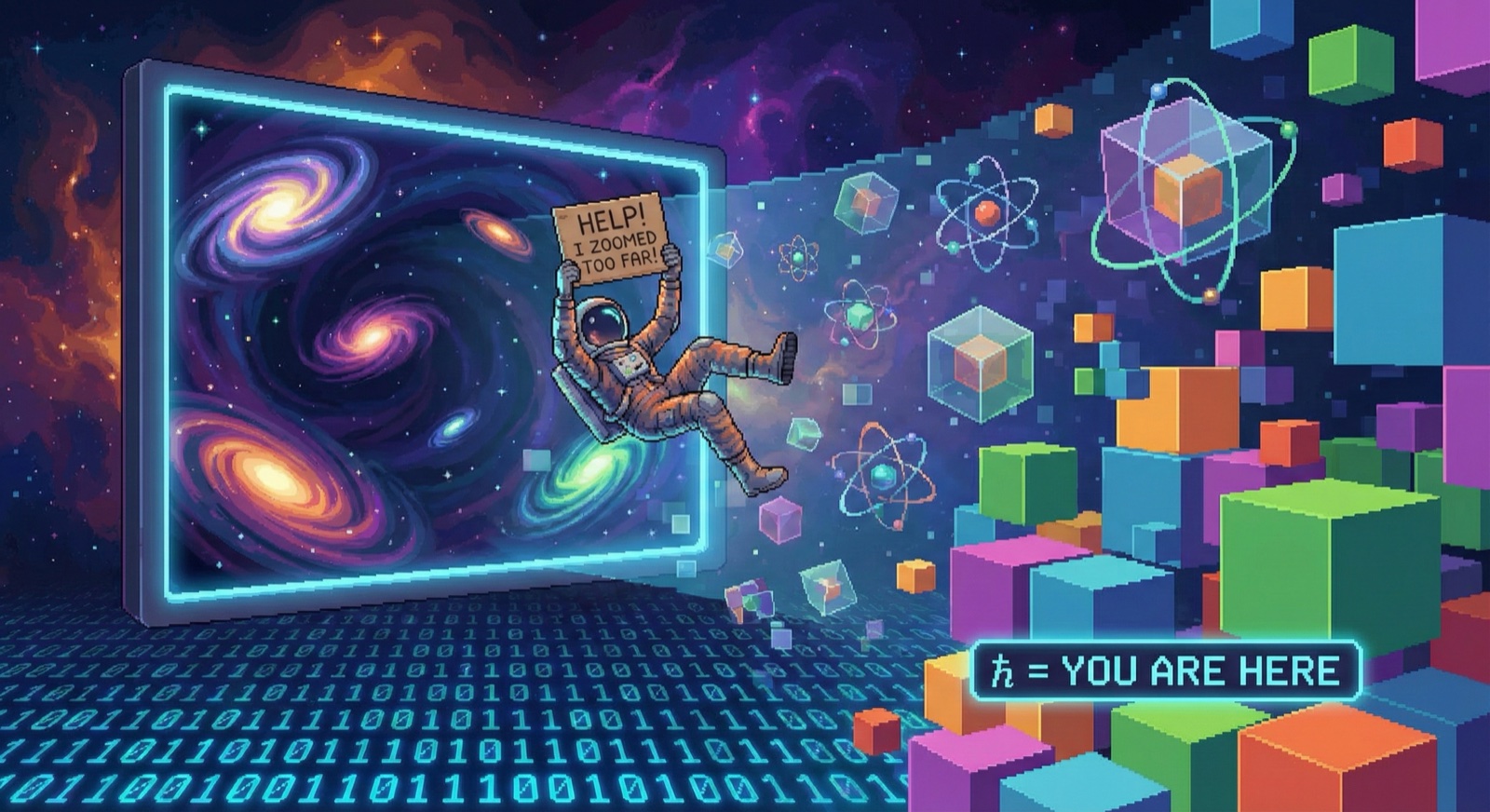
For a century, we've been told that position and momentum cannot both be known precisely — that this is a fundamental limit of reality. This is false. It is not a limit of reality. It is a limit of resolution. In a discrete voxel network, Heisenberg's principle becomes a trivial consequence of signal processing: the time-frequency tradeoff that every audio engineer knows. $\hbar$ is not a mystical constant. It is the pixel size of spacetime.
The Uncertainty Principle is often presented as proof that "nature is fundamentally fuzzy" — that randomness is woven into the fabric of existence.
In the framework of the Discrete Voxel Network, this interpretation is backwards.
Nature is perfectly sharp. The graph is binary — edges exist or they don't. Nodes are connected or they're not. There is no fuzziness in the adjacency matrix.
Heisenberg is not a property of the particle. It is a property of signal processing on a discrete lattice.
The "blur" of quantum mechanics is actually the "pixelation" of a rigid grid.
I. The Musical Analogy
Forget particles for a moment. Think about music.
Position ($x$)
The precise instant in time $t$. "What is happening at this exact moment?"
Momentum ($p$)
The frequency of the note. "What pitch is being played?" (wavelength $\lambda$)
Now try to answer this question:
"What is the exact frequency of the note being played at the precise instant $t = 3.7294$ seconds?"
It's impossible.
1.1 Why You Can't Know Both
To measure a frequency, you need to observe oscillations. A wave must go up and down at least once for you to measure how fast it oscillates.
- If you listen for a long time (large $\Delta t$), you can measure the frequency precisely
- If you reduce the listening window to a single instant, the wave disappears. All you hear is a "click"
This is not magic. This is the Fourier uncertainty principle, known to every audio engineer:
$$\Delta t \cdot \Delta f \geq \frac{1}{4\pi}$$
You cannot see the pattern (frequency) and the pixel (instant) at the same time. Zoom into the pixel, lose the pattern. Zoom out to see the pattern, lose the pixel.
This is not a quantum mystery. It's a mathematical identity. It applies to MP3 files, radio waves, ocean tides, and anything that oscillates.
II. Heisenberg on the Graph
Now apply this to our Topological Proton on the voxel network.
Position ($x$)
"Which node of the graph is the center of the knot?"
Momentum ($p$)
"How does the graph vibrate around the knot?" (The wavelength $\lambda = h/p$)
To measure the momentum (velocity), you must measure the wavelength of the network's deformation — the ripple pattern spreading from the particle.
But to measure a wavelength, you need to observe multiple nodes. A wave needs space to wave.
If you try to force a position measurement by looking at a single node, you lose all information about the wave passing through that node.
Conversely, if you measure the wavelength precisely (looking at many nodes), you lose track of which specific node the particle "is at."
This is the physical version of the Fourier inequality. Nothing more.
III. Topological Stress
There's an even more physical interpretation in the voxel framework.
A particle is a complex knot ($6\pi^5$). It needs room to exist — its topological structure occupies a certain volume $\pi^5$ in phase space.
3.1 The Compression Effect
If you try to "trap" this knot in a region smaller than its natural size (by measuring position $x$ very precisely), you compress the network.
Step 1: You force the knot into a tiny region (precise $x$ measurement)
Step 2: The graph reacts like a compressed spring
Step 3: Local tension explodes
Step 4: This tension releases as violent, unpredictable network vibrations
Result: The momentum $p$ becomes huge and chaotic
It's not that the particle "has" a fuzzy velocity. It's that your measurement stressed the network. You squeezed the balloon too hard, and it shot out of your hands.
3.2 The Energy Cost
This connects to our mass derivation. Recall that confining a system to volume $V$ costs energy:
Smaller confinement = higher energy = larger momentum fluctuations. The uncertainty principle is just the bookkeeping of this topological stress.
IV. What $\hbar$ Really Measures
In standard quantum mechanics, $\hbar$ (Planck's reduced constant) is treated as a fundamental, irreducible fact about the universe.
In Framework C, we see what it actually is:
$\hbar$ is the minimum action — the smallest "click" of change the universe can register.
In a continuous universe, $\hbar$ would be zero. You could subdivide motion forever.
The fact that $\hbar > 0$ is proof that spacetime is discrete. There is a smallest pixel. Below that scale, physics stops making sense — not because reality is "fuzzy," but because you've hit the resolution limit of the display.
Continuous Space
$\hbar = 0$
Infinite precision possible
No uncertainty principle
(Not our universe)
Discrete Graph
$\hbar > 0$
Minimum pixel size
Heisenberg emerges
(Our universe)
V. The Demystification
Let's summarize what Heisenberg's principle actually tells us:
| Old Interpretation | Framework C |
|---|---|
| "Nature is fundamentally random" | Nature is deterministic but granular |
| "The particle has no definite position" | Position and wavelength require different scales to measure |
| "$\hbar$ is a mysterious constant" | $\hbar$ is the pixel size of the network |
| "Uncertainty is a veil over reality" | Uncertainty is the resolution of the screen |
Heisenberg does not prove that the world is random.
Heisenberg proves that the world is granular.
If space were continuous, you could measure $x$ and $p$ to infinite precision. The fact that there's a limit ($\hbar$) is absolute proof that we live in a discrete graph.
VI. Conclusion: The End of Mystery
The uncertainty principle was the last fortress of quantum mysticism. It seemed to prove that reality itself was foggy, that God plays dice, that determinism was dead.
We now see the truth:
- Heisenberg is Fourier in disguise — a signal processing constraint
- $\hbar$ is the pixel size of the voxel network
- Uncertainty is resolution, not randomness
- The world is sharp, not blurry — we're just zoomed in too far
When you zoom past the pixels on a monitor, the image doesn't become "fuzzy" — it becomes discrete. You see the hard edges of individual elements. That's not a failure of the image. That's what the image is.
The universe is the same. At the scale of $\hbar$, you don't see blur. You see the grid.
God does not play dice. God renders at a fixed resolution. The apparent randomness of quantum mechanics is not the chaos of chance — it is the granularity of existence. We are not uncertain about reality. We are simply trying to read between the pixels.