"Something is rotten in the kingdom of galaxies."
Abstract
According to Newton's law, gravity weakens as you move away from the center ($1/R^2$). Stars at galactic edges should orbit slowly. But they orbit fast. Too fast. Their velocity stays constant ($V \approx \text{const}$), as if pulled by an invisible force. The standard answer is Dark Matter. This is a category error. It is not the Mass ($M$) that changes, but the Law of Gravity ($G$) itself, due to a thermodynamic regime change.
Here is the mathematical proof that Dark Matter is an illusion created by Volume Entropy.
I. The Duel: Surface vs Volume
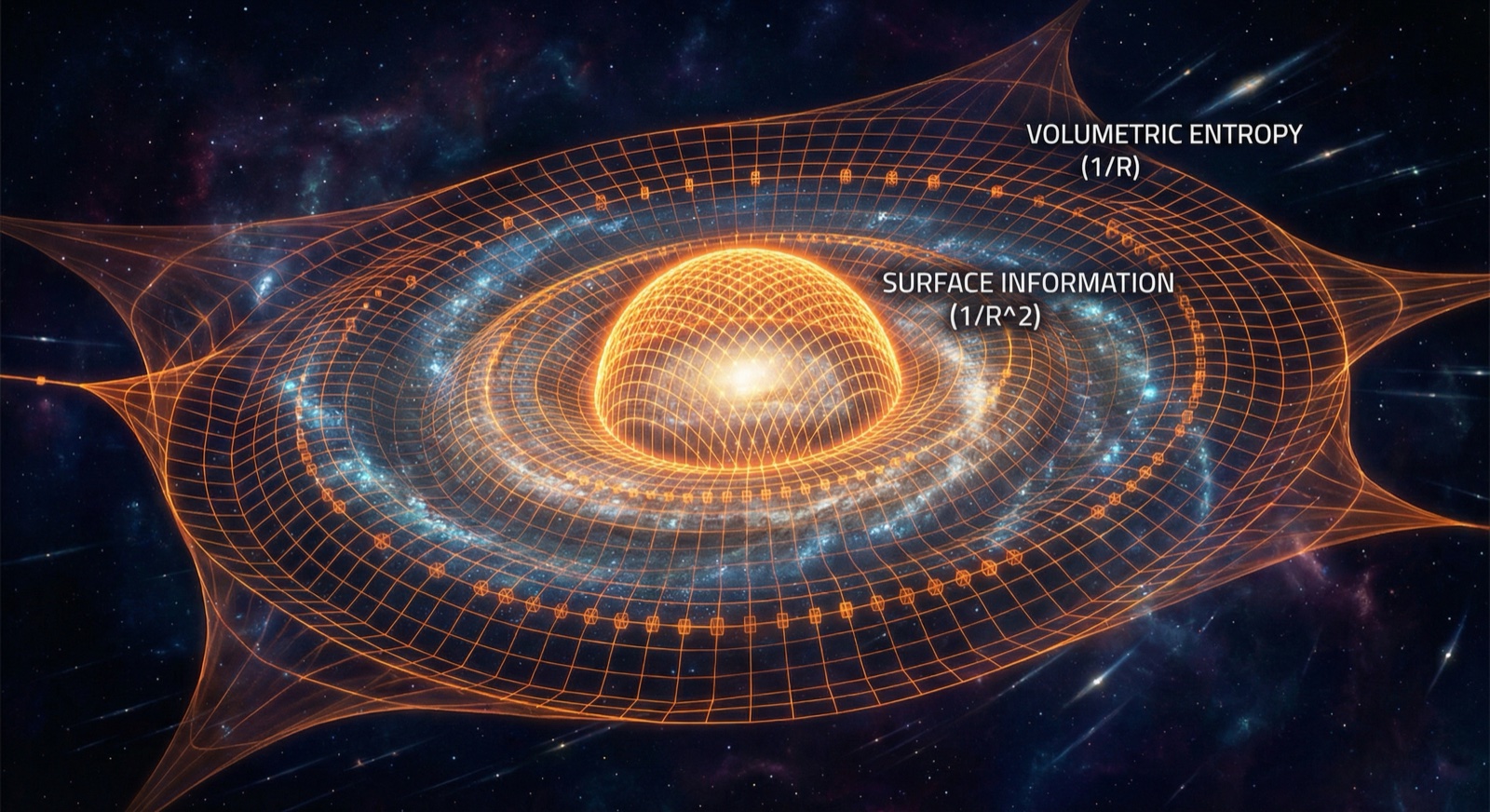
In a Graph Universe, information ($N$ bits) is not an abstraction — it is a physical occupation of space. There exist two storage modes for gravitational information:
Newtonian Mode (Surface)
At short distances (strong acceleration), information is projected onto a holographic sphere of radius $R$.
$N_S = \frac{A}{\ell_P^2} = \frac{4\pi R^2}{\ell_P^2}$
This is the standard regime described by Bekenstein and Hawking.
Galactic Mode (Volume)
At very large distances (weak acceleration), the network is no longer dominated by central mass, but by vacuum energy itself ($\Lambda$ or $L_H$). Information "leaks" from the surface to permeate the graph's volume.
$N_V = \frac{V}{\ell_P^2 L_H} = \frac{4\pi R^3}{3 \ell_P^2 L_H}$
Gravity changes its law when volume entropic noise exceeds the surface signal ($N_V > N_S$).
This occurs when $R \approx L_H$ (local cosmological scale), which corresponds exactly to the scale where we "detect" dark matter.
II. The Thermodynamic Derivation
Gravitational Force $F$ is an entropic force. It emerges from the system's tendency to maximize its entropy $S$:
Where $T$ is the "Temperature" (energy density per bit) of the network.
A. In the Surface Regime (Newton)
Energy $E=Mc^2$ is distributed across $N_S$ bits (Surface):
The entropy gradient $\nabla S$ for radial displacement is constant (1 bit per Planck length).
B. In the Volume Regime (Galactic)
Here, system energy is coupled to Volume. The network becomes "elastic".
According to Verlinde's relation for elastic media, energy density is no longer diluted by surface area, but responds to the stiffness of the vacuum (the minimal acceleration $a_0 \sim c H_0$).
In this regime, gravitational response becomes the geometric mean between matter's response ($g_N$) and the vacuum's response ($a_0$).
Why? Because the graph seeks equilibrium between its surface tension and its volume pressure.
Substituting Newtonian gravity $g_N = GM/R^2$:
III. The Proof of 1/R
Look at the equation above. The square root has transformed $1/R^2$ into $\mathbf{1/R}$.
IV. Constant Orbital Velocity
Apply this force to an orbiting star (Centrifugal Force = Volume Gravitational Force):
The radii $R$ cancel on each side!
The rotation curve is flat.
V. Rigorous Conclusion
What we call "Dark Matter" is not a mysterious particle.
It is the signature of Volume Entropy ($N_V$) taking over from Surface Entropy ($N_S$) at galactic scales.
Near the Center
The Graph behaves like a surface.
Gravity follows $1/R^2$.
Classical Newtonian regime.
Far from the Center
The Graph behaves like an elastic volume.
Gravity follows $1/R$.
Galactic regime (MOND).
The universe is not filled with massive ghosts.
It is simply filled with a vacuum that has memory storage capacity scaling as $R^3$.
Dark Matter is the ghost in the machine — an illusion created by our insistence on applying a surface law ($1/R^2$) to a volume regime ($1/R$). The voxel graph does not lie. It simply changes its counting mode.