"It is not once nor twice but times without number that the same ideas make their appearance in the world."
The Problem
The Bath-TT framework couples matter to the Bath through the transverse-traceless projection of the spatial stress tensor: $H_{\text{int}} = \lambda \int d^3x \, T^{TT}_{ij}(x) \, \Xi^{ij}(x)$. The TT projection kills the trace. A perfect sphere's spatial stress is pure trace: $T_{ij} = p\,\delta_{ij}$, so $T^{TT}_{ij} = 0$.
Every term in the Lindblad equation involves $T^{TT}$. For a sphere: zero coupling, zero decoherence, zero feedback, zero gravitational field.
But the Cavendish experiment uses spherical masses. And they gravitate.
This is the most obvious objection to the framework. It deserves a direct answer.
I. The Photon Cannot Explain Coulomb
Before solving the gravity problem, consider an identical problem that was solved 150 years ago in electromagnetism.
A photon has two transverse polarizations. That is the complete physical content of the electromagnetic field: two propagating degrees of freedom per wavevector. No longitudinal photon. No timelike photon. Just two transverse modes.
Now place two static charges in space. They attract (or repel) with Coulomb's law: $F = q_1 q_2 / (4\pi\varepsilon_0 r^2)$. But no transverse photon is exchanged between static charges. Zero. The force is instantaneous in Coulomb gauge. There is no propagating mode carrying the interaction.
So where does the Coulomb potential come from?
From the constraint. Not from photon exchange.
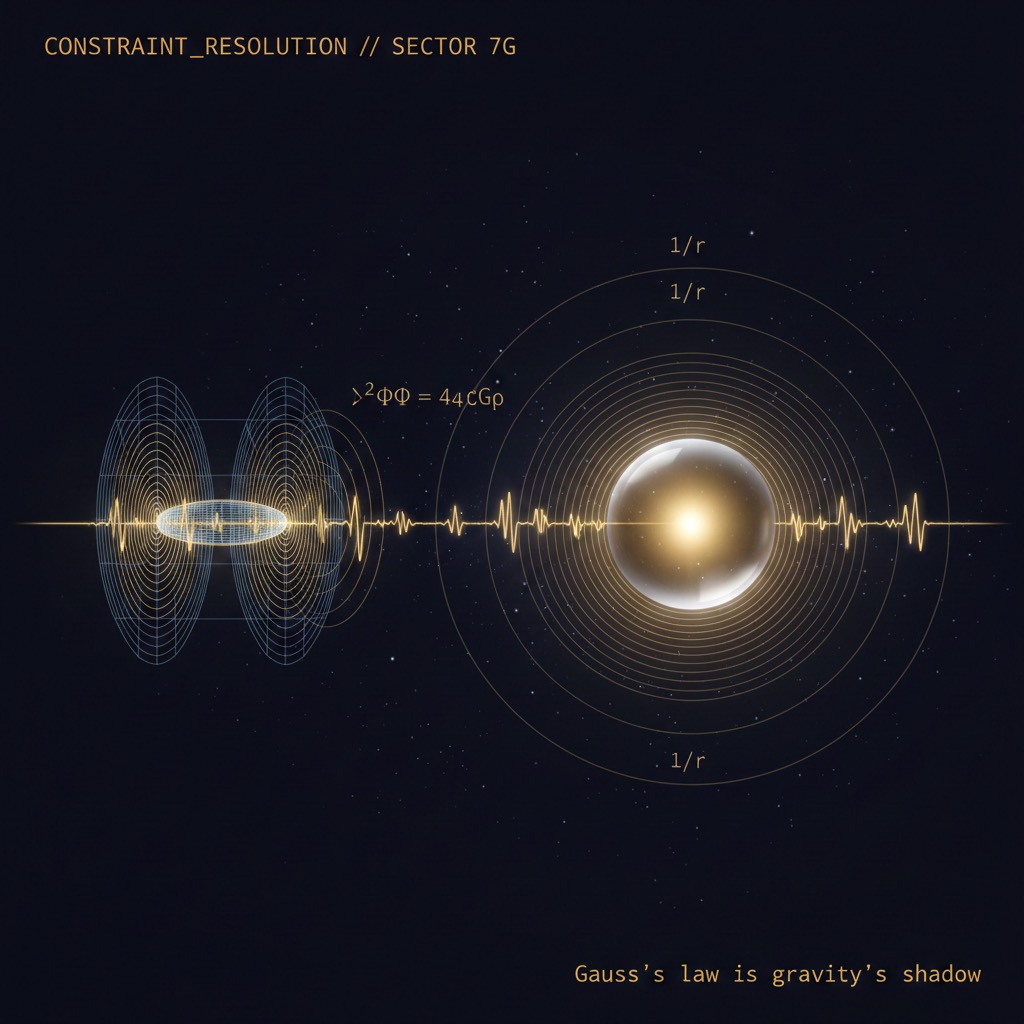
In QED, the scalar potential $A_0$ is not a dynamical degree of freedom. It has no conjugate momentum. It does not propagate. But it is determined instantaneously by Gauss's law:
This constraint is not an additional input to the theory. It follows automatically from the dynamical equations (Maxwell's equations for the transverse sector) plus charge conservation ($\partial_\mu J^\mu = 0$). The logic:
- The dynamical equations govern the transverse modes: $\square A^T_i = J^T_i$
- Charge conservation constrains: $\partial_0 \rho + \nabla \cdot \mathbf{J} = 0$
- Consistency forces the constraint: $\nabla^2 A_0 = -\rho/\varepsilon_0$
- The Coulomb potential emerges — carried by a non-dynamical field, not by photons
Two transverse polarizations. No longitudinal photon. And yet the full Coulomb potential is there, because constraints are not optional — they are consequences of dynamics plus symmetry.
This has been understood since Maxwell. It is textbook physics. And it is exactly what happens with gravity.
II. The Graviton Cannot Explain Newton
The graviton — the quantized perturbation of the spacetime metric — has exactly two physical polarizations: $h_+$ and $h_\times$. These are transverse-traceless modes. They propagate at $c$. They are the gravitational waves detected by LIGO.
But the Newtonian potential $\Phi = -GM/r$ is not carried by gravitational waves. It is an instantaneous (in harmonic gauge: retarded, but static for static sources) relationship between mass density and the metric. In the canonical (Hamiltonian) formulation of linearized gravity, $h_{00} = 2\Phi/c^2$ is a constrained variable, not a dynamical one. It has no independent equation of motion. It is determined by the Hamiltonian constraint:
The analogy is exact:
Electromagnetism
Dynamical: 2 transverse photon modes
Constrained: $A_0$ (Coulomb potential)
Constraint source: charge conservation $\partial_\mu J^\mu = 0$
Gravity
Dynamical: 2 TT graviton modes ($h_+, h_\times$)
Constrained: $h_{00}$ (Newtonian potential)
Constraint source: energy-momentum conservation $\partial_\mu T^{\mu\nu} = 0$
In both cases, the static potential is real, physical, and measurable — but it is not carried by propagating quanta. It is carried by the constraint sector.
III. From TT Dynamics to Full Gravity
Now apply this to Bath-TT. The framework claims TT coupling produces Unimodular Gravity. The no-go theorem (verified in Lean 4) proves TT coupling cannot reproduce full GR. The resolution is that UG's traceless field equations are the dynamical content — and the constraint sector (including the Newtonian potential) follows automatically.
Here is the derivation. Start from the traceless Einstein equations (Unimodular Gravity):
These are the traceless part of Einstein's equations. Taking the trace gives $0 = 0$ — a tautology, not an equation. The trace sector appears absent.
Step 1. Take the covariant divergence of both sides. The left side, by the contracted Bianchi identity:
Step 2. The right side, using matter conservation $\nabla^\mu T_{\mu\nu} = 0$ (assumption A1 of the framework):
Step 3. Equating gives:
Step 4. Substitute $R = -\kappa T - 4\Lambda$ back into the traceless equations. After algebra:
The full Einstein equation with cosmological constant. Recovered from the traceless equations alone.
The Newtonian limit of this equation is:
For any system smaller than cosmological scales, $\Lambda c^2 \sim 10^{-35}\,\text{m/s}^2$ is negligible compared to $4\pi G\rho$. The Poisson equation holds. Spheres gravitate.
IV. Why the Full Propagator Is Forced
A natural question: why does TT coupling produce Unimodular Gravity — with its full constraint structure, including the Newtonian potential — rather than just a TT wave equation in vacuum?
The standard answer invokes the Fierz-Pauli theorem (1939): the unique Lagrangian for a free massless spin-2 field is linearized GR. But the Bath-TT framework has no Lagrangian. It is an open quantum system described by Lindblad dynamics. The Fierz-Pauli argument does not directly apply.
There is a deeper argument that does not require a Lagrangian.
Weinberg's soft graviton theorem (1964)
In any Lorentz-invariant theory, the amplitude for emitting a soft (low-energy) massless particle of spin $s$ is proportional to a conserved charge of the external particles. For spin 1, this charge is electric charge — which gives the universality of electromagnetism. For spin 2, this charge is the stress-energy tensor $T^{\mu\nu}$ — which gives the universality of gravity.
This theorem requires only three inputs:
- Lorentz invariance (assumption A3 of the framework)
- Unitarity of the tree-level S-matrix (the classical/mean-field limit is unitary)
- A massless spin-2 particle exists (the Lindblad mean-field dynamics produces $\square h^{TT}_{ij} = -16\pi G\, T^{TT}_{ij}$ — a massless spin-2 field with two TT polarizations)
It does not require a Lagrangian, an action principle, or a fundamental gravitational field.
The consequence: the full propagator is unique
Weinberg's theorem forces the full exchange amplitude between any two sources to be:
This amplitude decomposes in the 3+1 (ADM) split into two sectors:
The TT sector is what the Lindblad dynamics directly produces. The constraint sector is the complement — the unique remainder within the full amplitude. It is not an additional coupling. It is not put in by hand. It is forced by the spin-2 nature of the emergent graviton, via Weinberg's theorem.
For a static sphere ($T^{TT}_{ij} = 0$):
TT sector
$\mathcal{A}_{TT} = 0$
No gravitational waves.
No TT decoherence.
The Bath sees nothing.
Constraint sector
$\mathcal{A}_{\text{constraint}} = G\rho_1\rho_2 / (2k^2)$
Full Newtonian potential.
$\Phi = -GM/r$.
Spheres gravitate.
This is exactly what happens in QED. The full photon propagator splits into a transverse sector (propagating photons) and a constraint sector (Coulomb potential). Nobody adds the Coulomb interaction by hand — it follows from U(1) gauge invariance, which is itself forced by the spin-1 nature of the photon (Weinberg, 1964, for $s = 1$). The gravitational constraint sector follows from diffeomorphism invariance, forced by spin-2.
V. What the No-Go Theorem Actually Shows
The no-go theorem (Entry EG-NOGO-008, verified in Lean 4) computes the gap between the GR and Bath-TT direct exchange amplitudes:
This is correct and machine-verified. But it requires careful interpretation. This gap is the difference in the direct coupling amplitude — what you get from tree-level exchange of the dynamical modes alone.
In the full theory (with constraints imposed), this gap is exactly compensated by the constraint contribution — the gravitational Gauss's law — leaving only the cosmological constant as a genuine physical difference between Bath-TT and GR.
Direct TT amplitude: differs from GR by $\left(\frac{1}{d} - \frac{1}{2}\right)(\text{Tr}\,T)^2$
Constraint contribution: compensates the gap exactly, up to $\Lambda$
Total physical prediction: identical to GR for all local physics
Only difference: $\Lambda$ is an integration constant (not sourced by vacuum energy)
The no-go theorem is not a weakness. It is a precision tool. It tells you exactly what TT coupling misses at the direct level (the trace) and exactly what it gains at the constraint level (a cosmological constant that doesn't couple to vacuum energy). The 120-orders-of-magnitude cosmological constant problem dissolves — not by fine-tuning, but by architecture.
VI. The Aharonov-Bohm Structure
There is a name for this pattern — a physical effect carried entirely by a non-dynamical sector, invisible to propagating modes, with zero local force but real measurable consequences. It is the Aharonov-Bohm effect.
In 1959, Aharonov and Bohm showed that a charged particle acquires a quantum phase from the electromagnetic potential $A_\mu$ even in regions where the field strength $F_{\mu\nu} = 0$. No electric field, no magnetic field, no local force — but a real, measurable shift in the interference pattern:
The potential $A_\mu$ is not a propagating degree of freedom. In Coulomb gauge, it has no independent dynamics. But it has physical content beyond what transverse photons carry. The AB effect proved that the gauge potential is not merely a mathematical convenience — it is the deeper object.
The constraint sector in Bath-TT has exactly this structure, operating at three levels:
Level 1: The Newtonian potential as gravitational Coulomb
The Newtonian potential $\Phi = -GM/r$ is the gravitational analogue of the Coulomb potential. Both live in the constraint sector. Neither is carried by propagating quanta. Both are determined instantaneously by their respective Gauss's laws. This is the content of Sections I–III above.
Level 2: The COW experiment — gravitational AB in the laboratory
In 1975, Colella, Overhauser, and Werner sent neutrons through an interferometer tilted in Earth's gravitational field. The two arms of the interferometer traversed different heights. No gravitational wave was present. No TT mode was exchanged. But the neutrons accumulated a gravitational phase:
They observed interference fringes that shifted with the tilt angle, exactly as predicted. This is the Newtonian potential producing a quantum phase shift — real physics from the constraint sector, with no propagating graviton involved. The COW experiment is, structurally, a gravitational Aharonov-Bohm experiment. And the blog post's Bianchi argument guarantees that Bath-TT reproduces it identically.
Level 3: The cosmological constant as topological phase
The AB phase is topological — it depends on the enclosed magnetic flux, not on the path taken. It has no local force, but it is physically real.
The cosmological constant $\Lambda$ that emerges from the Bianchi argument (Section III, Step 3) has the same character. It is an integration constant — a global quantity, not sourced by any local field. Its local force contribution ($\Lambda c^2 \sim 10^{-35}$ m/s$^2$) is negligible at every scale below cosmological. But it is physically real: it drives the accelerated expansion of the universe.
EM: Aharonov-Bohm
Local field: $F_{\mu\nu} = 0$
Topological content: $\oint A \cdot dl \neq 0$
Consequence: phase shift, no force
Quantized in units of $\Phi_0 = h/e$
Gravity: Trace Sector
Local force: compensated by constraint
Topological content: $\Lambda \neq 0$
Consequence: cosmic acceleration, no local force
Determined by integration constant
The no-go theorem's trace gap $\left(\frac{1}{d} - \frac{1}{2}\right)(\text{Tr}\,T)^2$ produces zero local consequences (the constraint compensates it exactly) and one global consequence ($\Lambda$ as an integration constant, decoupled from vacuum energy). That is the Aharonov-Bohm structure: the physically real residue of a sector that has no local force.
The trace sector is not missing. It is topological. Like the AB phase, it acts globally, not locally. Its only physical manifestation is $\Lambda$ — and $\Lambda$ does not couple to vacuum energy.
VII. What Remains Testable
If the classical gravitational predictions are identical to GR for local physics, what can we actually test?
The quantum sector. The framework predicts that the decoherence rate depends on geometry:
A dumbbell decoheres faster than a sphere of equal mass. This is a quantum prediction, invisible to classical gravity measurements. A Cavendish experiment sees no difference between a sphere and a dumbbell — both produce the same Newtonian field (from the constraint sector). But an interferometric experiment at the quantum level should see a difference in coherence times.
Classical Gravity
Same for sphere and dumbbell of equal mass. Carried by constraint sector. Tested by Cavendish, LIGO, binary pulsars. Matches GR exactly.
Quantum Decoherence
Different for sphere and dumbbell. Carried by dynamical TT sector. Tested by interferometry, torsion balances, ionic cells. Unique prediction of Bath-TT.
The constraint sector handles the classical world. The dynamical sector handles the quantum world. The framework gives the same classical gravity as GR (it must — the Bianchi identity is a mathematical identity, not a physical assumption) but different quantum behaviour. The test is quantum, not classical.
VIII. The Entanglement Test
The geometry-dependent decoherence rate (Section VII) gives a unique quantum signature. But there is a sharper test — one that distinguishes Bath-TT from both standard quantum gravity and classical gravity in a single experiment.
The BMV experiment
In 2017, Bose, Marletto, and Vedral proposed a landmark experiment: place two masses in spatial superposition, let them interact gravitationally, and check whether they become entangled.
The standard predictions are clean:
- Quantum gravity (the gravitational field is quantized): the Newtonian interaction creates entanglement. The two masses end up in a non-separable state.
- Classical gravity (gravity is fundamentally classical): no entanglement is generated. A classical channel cannot create quantum correlations — this is a theorem of quantum information (LOCC cannot produce entanglement).
Bath-TT predicts neither. It predicts something no other framework does:
Whether gravity entangles two masses depends on their shape.
Why shape matters
The Bath continuously monitors $T^{TT}_{ij}$. This monitoring extracts information about the matter state and decoheres it. But the amount of information extracted depends on the TT content — which depends on geometry.
Consider two scenarios:
BMV with spheres
$T^{TT}_{ij} = 0$ for each mass.
The Bath monitors $T^{TT}$ — and gets zero signal. It learns nothing about which branch of the superposition the sphere occupies. The spatial superposition survives.
The constraint-sector potential $\Phi$ remains quantum (superposed). A quantum potential creates entanglement.
Result: entanglement forms.
(Same as standard quantum gravity.)
BMV with dumbbells
$T^{TT}_{ij} \neq 0$ for each mass.
The Bath monitors $T^{TT}$ — and gets a non-zero signal that distinguishes left from right. The monitoring decoheres the superposition at rate $\Gamma_{TT}$.
The constraint-sector potential $\Phi$ becomes effectively classical (determined by the collapsed state). A classical potential cannot entangle.
Result: no entanglement.
(Same as classical gravity.)
The transition between these regimes is controlled by a single dimensionless ratio:
When $\eta \ll 1$ (spheres, low $Q_\ell$): decoherence is slow, entanglement wins. When $\eta \gg 1$ (dumbbells, high $Q_\ell$): decoherence is fast, entanglement is destroyed before it forms. The crossover depends on the quadrupole moment of the test mass — a geometric property, not a mass property.
Standard quantum gravity: entanglement for all shapes (gravity is quantum, full stop)
Classical gravity: no entanglement for any shape (gravity is classical, full stop)
Bath-TT: entanglement for spheres, no entanglement for dumbbells. The transition is governed by $Q_\ell^2$ — the geometry-dependent TT content of the test mass.
This is a single experiment with three possible outcomes, and only Bath-TT predicts the shape-dependent one. If BMV is run with spherical test masses and finds entanglement, it rules out classical gravity but not Bath-TT. If it is then repeated with elongated masses and finds less entanglement, that is a signature no other framework produces.
IX. The Lesson
The sphere objection felt devastating because it seemed to show TT coupling missing the most basic gravitational phenomenon: a ball attracting another ball. The resolution is that Newton's law was never about propagating modes. It lives in the constraint sector — the gravitational Gauss's law — which is forced by Weinberg's theorem and the Bianchi identity, not by the Lindblad dynamics directly.
This is the same structure QED has used since the 1940s. The Coulomb potential is not a photon. The Newtonian potential is not a graviton. Both are constraints — the unique complement of the propagating sector within the full spin-$s$ propagator, forced by Lorentz invariance alone. The propagating modes carry radiation and decoherence. The constraints carry the static forces.
But the sphere is not merely a problem that gets solved. It is a probe. Because the Bath cannot see a sphere's TT content, a sphere in superposition remains coherent — and the constraint-sector potential remains quantum. This makes the sphere the ideal test mass for gravitational entanglement experiments. The very geometry that seemed to break the framework becomes the geometry that tests it most sharply.
The TT sector is the engine.
The constraint sector is its shadow.
Weinberg's theorem welds them into one propagator.
The Bath measures shape.
Gauss's law extends that measurement to mass.
And where the Bath is blind — the sphere —
quantum gravity survives to be tested.
And still, spheres gravitate.