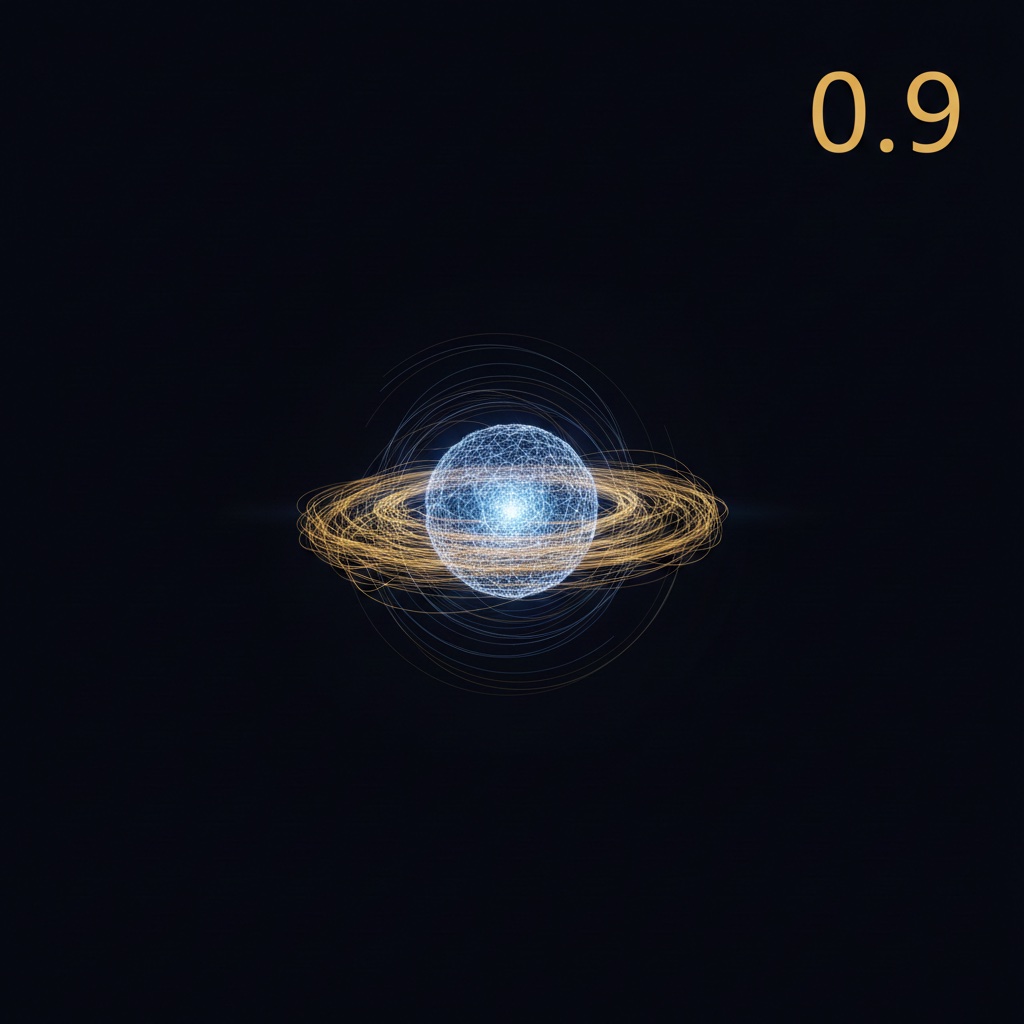
A pulsar is a neutron star that spins. It spins because angular momentum is conserved — a star the mass of the Sun, collapsed into a sphere twenty kilometres across, keeps the rotation of its progenitor. Some complete hundreds of revolutions per second.
They slow down. The magnetic field, tilted against the rotation axis, flings electromagnetic radiation into space. The spin decelerates.
The relationship between the deceleration and the spin rate is a power law:
The exponent $n$ is called the braking index. It is measured directly from pulse timing — the period, its first derivative, and its second derivative, tracked over years of observation:
For pure magnetic dipole radiation, $n = 3$. Not approximately. Exactly.
Here is what nature says.
| Source | n |
|---|---|
| Dipole prediction | 3.00 |
| PSR J1119−6127 | 2.68 |
| Crab (B0531+21) | 2.51 |
| PSR B0540−69 | 2.14 |
| Vela (B0833−45) | 1.4 ± 0.2 |
| PSR J1734−3333 | 0.9 ± 0.2 |
Every measured braking index is below 3.
The standard explanations — magnetic field evolution, magnetospheric particle winds, progressive alignment of the dipole axis — can account for indices around 2.5. Below 2, they strain. At 0.9, they are silent.
Suppose two torques act on every pulsar. The first is magnetic dipole radiation — the known mechanism:
The second is a friction proportional to angular velocity:
Both act together. The effective braking index falls between 3 and 1, depending on which torque dominates. For fast, strongly magnetised pulsars, dipole radiation wins and $n$ sits near 3. As a pulsar slows, the cubic term fades. The linear term persists.
Look at the table again. It is not five normal pulsars and one anomaly. It is a gradient — every measured index pulled below 3, toward 1. PSR J1734−3333, with $P = 1.17\;\text{s}$, is simply the slowest in the sample. The friction has won.
0.9 ± 0.2 is consistent with 1.