In plain words
In the very early Universe, gravity in this model was much stronger at the scale of the first collapsing gas clouds, because the scale that sets the anomaly grows with the expansion rate, which was far larger then. Two things follow. The first stars would have been tens of times the Sun's mass rather than hundreds, which fits the fact that nobody has found the chemical fingerprint of the giant explosions that very massive first stars leave behind. And the seeds of the giant black holes would have formed easily in most early galaxies, which is what the James Webb telescope's oversized early black holes seem to need. The page then checks both against the latest data, and says exactly what would kill them. Unfamiliar words are in the glossary.
Two ingredients of the model
Why the early Universe, and not the collapse itself.
Plain MOND, with a constant a₀, does almost nothing at z = 20: the clouds sit near u ~ 1. This model does, for two reasons of its own.
First, the scale is cosmological: a₀ = cH₀/2π today, and a₀(z) ∝ H(z) if the de Sitter thermostat sets it, or ∝ (1+z)3/2 if the density of a diluting medium does. Either way a₀ is 20 to 130 times larger at z = 10–25, and the collapsing clouds are deep in the MOND regime, u = 10−3 to 10−2, with an effective gravity boosted by ν = 5 to 30. Second, the response is to the enclosed mass: the homogeneous background exerts on a 100 pc halo at z = 20 a field ubg = πR/RH = 4×10⁻⁶. There is no cosmological external-field effect to switch the boost off. Both ingredients are assumptions of the model, named on the Black holes page; the a₀(z) rise is contested by MUSE-DARK II and favoured by MUSE-DARK III, and nothing measures it at z > 10.
| z | a₀(z)/a₀ (H, dilution) | Pop III cloud, 103 M☉ at 1 pc: ν | Atomic-cooling halo, 108 M☉ at 1 kpc: ν |
|---|---|---|---|
| 10 | 20, 36 | 4.5–5.8 | 13–17 |
| 15 | 36, 64 | 5.8–7.6 | 17–23 |
| 20 | 54, 96 | 7.0–9.2 | 21–28 |
| 25 | 74, 133 | 8.1–10.7 | 24–33 |
Prediction 1
The first stars weigh tens of solar masses, not hundreds.
The mass of a Population III star is set at the “loitering” phase of H2 cooling, about 103 M☉ of gas at 1 pc and 200 K, where the Jeans mass is near 2,000 M☉ and the standard outcome is stars of 30 to 300 M☉. With the effective gravity boosted by ν, the Jeans mass scales as ν−3/2: it falls to 60–200 M☉, ten to thirty times lower. The characteristic mass of the first stars falls with it, to a few to thirty solar masses. Consequences: few or no pair-instability supernovae, which need 140–260 M☉; first-generation black holes of 10–40 M☉, not 100–300; a flat, truncated Pop III mass function.
Prediction 2
Heavy seeds become generic.
In an atomic-cooling halo of 108 M☉ (gas 1.5×10⁷ at 1 kpc, 8,000 K), the gas free-fall time drops from 135 Myr to 24–37 Myr and the inflow from 0.11 to 0.4–0.6 M☉ per year, above the 0.1 M☉/yr threshold for a supermassive star, with no extreme Lyman–Werner background required. The Jeans mass of the atomic gas stays at 106 M☉, so fragmentation does not prevent the supermassive star. The model does not touch the Eddington limit, which is Newtonian near the hole; it multiplies the supply from large scales by √ν ≈ 4–6. Result: seeds of 104–105 M☉ in most atomic-cooling halos at z = 15–25, hence black holes of 107–108 M☉ at z = 10 without super-Eddington growth.
| Seed | Born at | Mass at z = 10.1, Eddington (ε = 0.1) | at half Eddington |
|---|---|---|---|
| 105 M☉ | z = 20 (278 Myr earlier) | 4.9×10⁷ | 2.2×10⁶ |
| 105 M☉ | z = 25 | 1.4×10⁸ | 3.7×10⁶ |
| 104 M☉ | z = 25 | 1.4×10⁷ | 3.7×10⁵ |
| 100 M☉ (light seed) | z = 25 | 1.4×10⁵ | 3.7×10³ |
2024–2026
The test, against the data.
Pair-instability descendants: zero, and it does not help.
No star with an unambiguous pair-instability signature is known. The one candidate, LAMOST J1010+2358 (Xing et al. 2023, a pure 260 M☉ descendant), was refuted three times in 2024: Skúladóttir et al. exclude more than 70% of its metals from a PISN, Jeena et al. fit it with a 12–14 M☉ core-collapse supernova, Thibodeaux et al., from a new Keck spectrum, conclude that “there are still no known stars displaying unambiguous signatures of pair-instability supernovae”. The prediction passes, but it passed before: on 962 stars at [Fe/H] < −2.5, Koutsouridou et al. (2024) exclude only the flattest mass functions, and a standard Larson IMF keeping 7% of its stars in the PISN range remains allowed. The absence of PISN descendants does not separate the model from the standard picture.
The He II emitter near GN-z11 pushes the other way.
Hebe, a pristine system at z ≈ 10.6 with more than half of its 2×10⁴–6×10⁵ M☉ in Population III stars (Rusta et al. 2026), shows HeII/Hγ > 0.7, which needs massive stars: a characteristic mass above 75 M☉ at the Salpeter slope. Combined with the near-field bound, the viable band is 176x − 331 ≤ mch ≤ 191x − 132. The model's characteristic mass, 3–30 M☉, lies in that band only for slopes x ≤ 2, and is excluded at Salpeter and steeper.
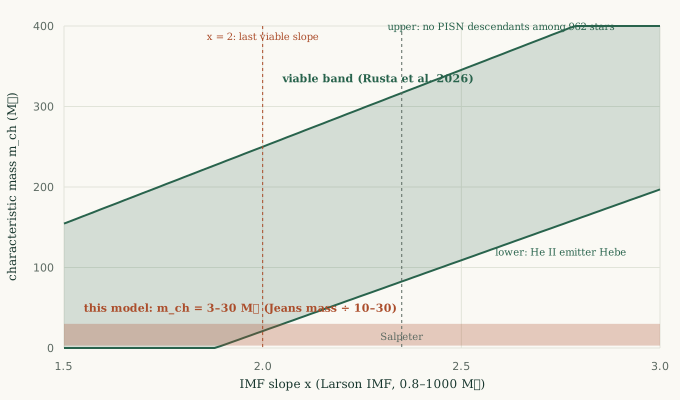
| Slope x | Viable mch (M☉) | Model at 3–30 M☉ |
|---|---|---|
| 1.9 | 3 – 231 | compatible |
| 2.0 | 21 – 250 | marginal |
| 2.2 | 56 – 288 | excluded |
| 2.35 (Salpeter) | 83 – 317 | excluded |
With a flat slope and a hard cutoff, the model's mass function gives a mean Pop III mass of 26–46 M☉ and 0–5% of PISN progenitors. Verdict: the prediction survives in one corner of the plane, x ≤ 2 and a cutoff near 100–200 M☉, and dies if the first stars' slope is Salpeter or steeper. Undecided, with the window named.
Heavy seeds: reproduced, not yet discriminated.
UHZ1 at z = 10.1 holds a 4×10⁷ M☉ black hole accreting at the Eddington rate in a galaxy of comparable stellar mass (Bogdán et al. 2024; Natarajan et al. 2024), read as a direct-collapse seed; GN-z11 at z = 10.6 holds 1.6×10⁶ (Maiolino et al. 2024); a 2026 study reproduces such an object from a 7×10⁴ M☉ seed born at z = 25.7 and growing at half the Eddington rate. In this model a 105 M☉ seed born at z = 20 reaches 4.9×10⁷ at z = 10.1: UHZ1, with nothing exotic. A light seed of 100 M☉ reaches 1.4×10⁵. The overmassive objects need heavy seeds; ΛCDM makes them in rare halos, this model in most. The discriminant is therefore the number density of heavy seeds. The abundance of the “little red dots” (10−5–10−4 per comoving Mpc³ at z ≈ 5–7) and the discovery of UHZ1 in a small field argue for “common”, but their nature is not settled. The test to run: count overmassive black-hole galaxies at z > 9 in JADES, CEERS and UNCOVER against “one per atomic-cooling halo”.
Falsifiable
What would kill it.
- A He II emitter requiring mch > 30 M☉ at a flat slope, or a measured Pop III slope at Salpeter or steeperkills prediction 1
- One unambiguous pair-instability descendant, or a pair-instability supernova at z > 10 seen by JWSTkills prediction 1
- Overmassive black holes at z > 9 rarer than one per atomic-cooling halo by a large factorkills prediction 2
- a₀ measured constant, or falling, at z > 2 (JWST rotation curves)kills both
Estimates on canonical configurations, not simulations; the boost factors ν are robust, the thresholds (0.1 M☉/yr, 140 M☉) are the literature's. Scripts: tn_premiers_tn.py, tn_test_popiii.py in ~/mond-coude/trous-noirs. Sources: Salvadori et al. 2019 (arXiv:1906.00994); Koutsouridou et al. 2024 (arXiv:2312.05309); Skúladóttir et al. 2024 (arXiv:2404.19086); Thibodeaux et al. 2024 (arXiv:2404.17078); Jeena et al. 2024 (MNRAS 527, 4790); Rusta et al. 2026 (arXiv:2603.20363); Natarajan et al. 2024 (arXiv:2308.02654); Bogdán et al. 2024 (arXiv:2305.15458); arXiv:2603.28682 (2026); Begelman 2010 and Hosokawa et al. 2013 for the supermassive-star threshold.